
California Plastic Surgeons and The Emergency Room
Seeing as the topic of plastic surgeons and emergency department coverage
in Southern California keeps coming back to the evening news and newspapers,
I thought it made sense to address it. At present many Plastic Surgeons
(myself included) look at covering emergency departments at local hospitals
as a losing proposition. Often emergency calls come in the late evening
and early morning hours and progressively fewer emergency patients seem
to have insurance coverage of any kind. Looking at my billing company statements
for 1999, I see roughly 40% of all my emergency department calls as uninsured.
Nearly 80% of them have paid nothing towards their bill or have disappeared
following their procedure. If this were happening less frequently, we could
look at it as "the cost of doing business." At it's present rate, it impacts
upon a surgeon's ability to pay the overhead. As you will see below, even
the patients who have insurance are reinbursed at rates that are mediocre
at best. Most surgeons run overhead at 50-60% of gross at the least.
A Few Examples Of Patients For Whom This Surgeon Was Called To The Emergency
Department
The patients listed below were covered by insurance at the time i managed
their injuries (Medicare plus a secondary as I recall). Their injury, procedure,
time spent, reimbursement and time to payment are listed. How people can
make money defrauding Medicare is beyond me. I can't even get paid adequately
for the things I do for them.
Case 1
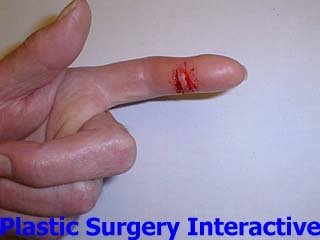
This pleasant 79 year old gentleman had injured the tip of his index finger
of his left hand on a table saw. The x-ray showed no fracture of the bone.
The emergency room physician felt that this hand injury required the attention
of a plastic surgeon.

The hand was examined and no nerve of joint injury was appreciated.
The laceration was cleaned and closed under local anesthesia. The surgeon's
time in the emergency room for this patient was 1 hour. Medicare and the
secondary reimbursed a total of: $21.39
three months after the case was billed (an average time). At this rate,
the case is not worth keeping the other patients waiting in the office.
I was late to see patients in the office as a result of taking care of
this gentleman.
Case 2
This (again) pleasant 77 year old gentleman had injured his forehead
and eyelid in a fall earlier the same day. Hopefully, few emergency department
physicians would undertake such an injury without assistance. No argument.
This patient was better served by having a plastic surgeon address these
injuries.
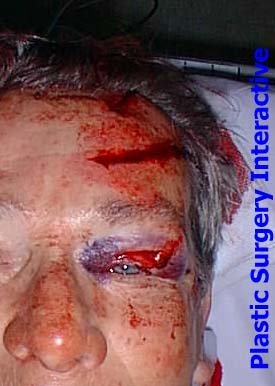
This patient's injuries were cleaned and closed under local anesthesia
in the emergency department. The surgeon's time in the emergency room for
this patient was 3 hours. Medicare and the secondary reimbursed a total
of: $283.14 two months after the
case was billed (a pretty good time).
I don't really have an issue with managing emergency patients, but if
only half of them have any coverage and those that do pay fairly poorly,
it is not worth getting up from bed to go see them. This is nothing personal
against people needing emergency care, but at these rates my coverage of
emergency departments is decreasing.
Hopefully, this will be seen as it has been designed; namely as an explanation
of the status of emergency plastic surgery in Southern California. Once
upon a time someone would be able to respond:
"But those were Medicare patients! My insurance pays
better! I have good insurance."
Seeing as most insurance companies in Southern California pay based
upon Medicare rates (often less than Medicare rates), your statement would
no longer be correct.
If you need health insurance, this online health insurance broker may be worth a look:
Note: This piece is written for the general information of those
seeking plastic surgery. It is presented freely in this format for this
purpose. No other rights are granted. It may not be duplicated, cited or
otherwise copied in any form without the written consent of the author.
Comments made are those based upon the author's experience with insurance
companies and are not meant to indicate how the reader's insurance company
may act on a particular issue.
EDITORIALS
MAIN | FEES & FINANCING